 |
| http://im.rediff.com
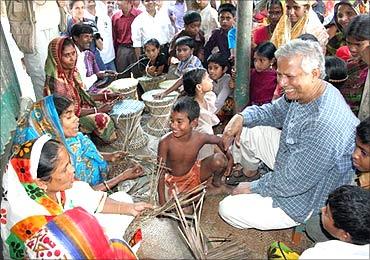
Muhammad Yunus, Nobel Prize winner and founder of the Grameen Bank, discusses his establishment of a social entrepreneurship in his book, Banker to the Poor. In 1983, Yunus opened Grameen, a bank devoted to providing the poorest of Bangladeshi people small loans. Most of his lenders are women, and he discusses how providing women with jobs and responsibility has not only empowered them, but also redefined gender roles within a rather traditional Bangladeshi society. His book discusses how Grameen has distinguished itself as a sustainable and successful bank.
In designing the structure of Grameen, Yunus researched methods of other banks, and adapted his own to make it more successful. He says, “In structuring our credit program, I decided to do the exactly the opposite of traditional banks.” Traditional banks often have a system of large loans over a long period of time, but Yunus decided to institute a daily payment program with loans so small it would be very unlikely to miss. Yunus faced several challenges in scouting and retaining members, especially women, who were discouraged from joining the workforce. He found that support groups were a viable way for women to reflect on their lives with other like minded women. He says, “A sense of intergroup and intragroup competition also encourages each member to be an achiever.” Finally, Yunus feels that maintaining trust between the loaners and lenders is a crucial part to its success. Clearly, their honor system has worked, since their bad debt rate is only 1%.
Grameen Bank is a social entrepreneurship which is giving more power to the poor, and their honest, easy practices cause women to gravitate towards them. Women are more responsible with the loans given to them because they want to prove their academic and economic abilities to a society which encourages their place in the home. This book offers more specific information on his creation of Grameen, which I plan to use in the next blog post.
|
Monday, April 4, 2016
Grameen Bank: Assisting the Most Disadvantaged in Bangladesh

Subscribe to:
Post Comments (Atom)
No comments:
Post a Comment
Note: Only a member of this blog may post a comment.